


Bedford Borough Council has been awarded the prestigious Bees’ Needs Champion Award 2025, recognising the Council’s commitment to protecting and enhancing habitats for pollinators across the borough.
This award follows the Council’s first win in 2021 for its Bugs and Bees Project.
However, a local Green councillor has said that all the good, award-winning work is being undone by the council’s continued use of toxic pesticides.

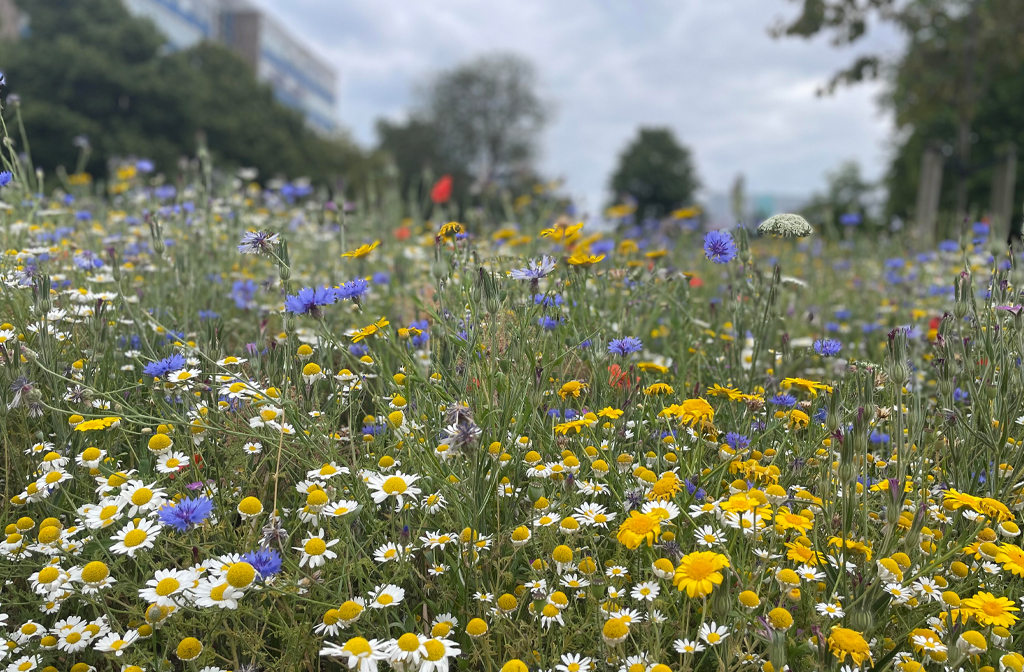
The Bees’ Needs Champion Award 2025 celebrates the Council’s work to safeguard open spaces from vehicles by planting wildflower-rich landscape features along park boundaries.
These not only prevent damage to Bedford Borough’s open spaces from vehicles but also create important nectar-rich habitats for bees, bugs, and other pollinators.
Since 2023, these efforts have been introduced at Putnoe Park (Bowhill), Newnham Avenue Open Space, Woodcote Open Space, and Chiltern Avenue Open Space.
The project, funded through Council Capital Funding, has helped to transform previously over-mown areas into thriving wildflower corridors, linking green spaces throughout Bedford Borough’s urban environment.
The work being done by the council supports biodiversity, enhances visitor experience, and encourages the wider community to take action in support of pollinators.
Toxic pesticides
Green councillor, Lucy Bywater (Castle ward), told the Bedford Independent: “I welcome the good work by officers on the Bugs and Bees Project in recent years and the fact that residents are able to suggest sites for enhancing habitats for nature is positive.
“It’s vital that the council leads by example in our nature-depleted country.
“But I’m concerned about the council’s routine use of pesticides – especially weedkiller on local roads, footpaths and in parks and the serious potential impact that has on nature and on pollinators in particular.
“So the good work on projects which win prizes is basically being undone in other areas. Many people will have seen the mini quad bikes going along their roads at least twice a year spraying all along the pavement.
“Regular use of toxic pesticides, which kill plants and insects, is not good for nature and is not good for human health either.”
Further information on safe alternatives to pesticides in urban areas can be found at The Pesticide Action Network website.
Published as part of our work experience partnership with Kimberley College
Additional reporting by Erica Roffe


