

Trust in journalism matters because when it goes, everything gets harder. Important stories, uncomfortable truths, and accountability only work if people trust that what they are reading is accurate and ethical.
We feel that pressure every day. At the Bedford Independent, we have championed accuracy, transparency and trust from the day we began. Our journalists are NCTJ-trained, members of the NUJ, and we are regulated by Impress with a clear complaints policy.

I’m also an accredited ethical journalist, and while that, nor anything else I’ve mentioned, makes us perfect, it sets out the standards we hold ourselves to and the route readers have to challenge us if we get something wrong.
Read: Bedford Independent editor among first accredited ethical journalists in UK
That’s why questions about trust are not academic. They are practical, shaping how people read the news, whom they believe, and what they dismiss.
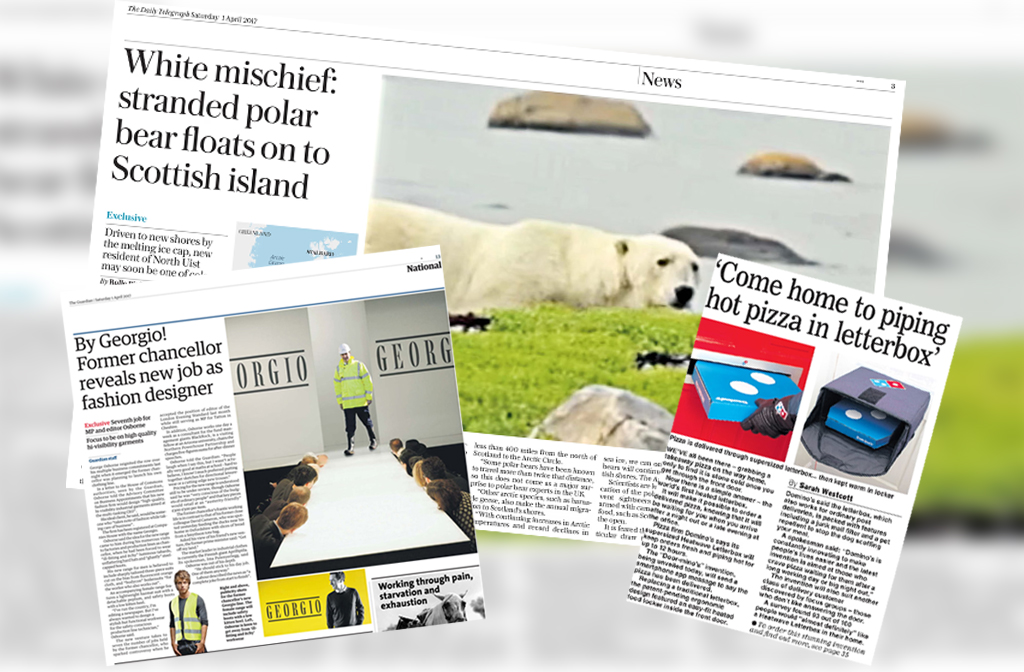
The ethics question recently came up while discussing April Fool’s stories in newspapers with my friend, Chris Gill, former editor of the Bedfordshire on Sunday, who is also NCTJ-trained and a life member of the NUJ, but who has an opposing view.
April Fool’s Day is one of those traditions that feels deeply British, but its true origins are murky. Historians have not pinned down a definitive start point, and serious theories place its emergence either in medieval England or in France around calendar changes.
What is clear is that the UK has been enjoying the tradition for centuries. One of the earliest recorded British April Fool’s pranks dates back to 1698, when people were tricked into going to the Tower of London to watch the non-existent “washing of the lions”.
And in 1957, even the BBC joined in with their famous spaghetti harvest hoax, which saw many criticise the BBC for airing the item on what is supposed to be a serious factual programme.
Read: ‘Spaghetti growing on trees’ – are we too wary of an April Fool’s prank? (BBC News)
The Bedford Independent has followed that tradition since we began, first playing on the popular comment about too many coffee shops in town to this year’s poke at making sure Bedford Park’s grass is pristine all year round.
Not hilarious to everyone, but surely a bit of fun for most.
Read: All our April Fool’s stories
But, in the age of fake news, should this tradition be dropped? Are April Fool’s stories in newspapers still ethical?
The case for – Paul Hutchinson, editor, Bedford Independent
I still think April Fool’s stories can be ethical, but only if they are done responsibly.
A lot of what passes for ‘pranks’ online now are not pranks at all. It’s misinformation dressed up as humour, shared without context, and left to spread long after the original poster has moved on. A newspaper should not be adding to that mess.
But a responsibly handled April Fool’s story is different. It has guardrails.
At the Bedford Independent, when we publish an April Fool’s Day joke, what we write is generally so outlandish that it will be hard to believe for many. We use fake names.
We do not cite official sources. We do not use real individuals as the target. We avoid sensitive subjects. And by midday, we reveal the “fool”.
The purpose is not to mislead readers for days on end. It is to give them a moment of shared silliness, then lift the curtain quickly and clearly.
In an age where there does seem to be bad news everywhere, an April Fool’s can bring a bit of fun to the coverage. It can be a chance to collectively laugh along with readers, even if some don’t find the joke as funny as others.
At the end of the day, it allows us to be a little more relaxed and enjoy the folly of a much-loved British tradition, while still being honest about what we are doing and where the line is.
To that end, the prank itself is not the point; it’s the relationship with our readers that allows us to enjoy the fun together.

The case against – Chris Gill, former editor, Bedfordshire on Sunday
There were days when news desks would spend weeks fine-tuning their April Fool’s Day story. It was a highlight of the advent of spring.
It became increasingly difficult over the years to come up with something funny, original and, of course, plausible that didn’t have people stop reading after the first paragraph.
But in modern day, it’s April Fool’s Day every day. Memes, AI, TikToks. The world is a different place. It should be filed under misinformation.
The gullible are being fooled by fake news on an hourly basis on social media. The world is so crazy that there’s hardly anything written or said that you need to spend a minute double-checking if it was true or not.
Newspapers get duped all the time. Resources are thin. Bizarre claims on social media are lifted at face value without checking. Fools them? Fools us for being taken in.
Years ago, long before interactive TV, I wrote a daily TV sports item in the Daily Express.
I told people that if they watched a football match on Sky and used their remote to align it to a player’s shirt number, they could select a man of the match. Fools galore, and there were plenty of calls the next morning saying that all that happened was the channel changed.
Who could have then predicted this foolish prank would, in fact, become a reality?
I don’t want to be a curmudgeon, but April Fool’s in newspapers are passé. If you want a challenge identifying fact or fiction, no need to wait until spring. Just read the news each day.
Over to you
So, where do you land?
Are April Fool’s stories still ethical if they’re handled responsibly, clearly labelled, and revealed quickly?
Or is Chris right that in today’s world, newspapers should stop adding even one more intentional falsehood to the mix?
I’d be really interested to hear who you agree with, and why. Write to us at letters@BedfordIndependent.co.uk or comment on our social pages under this story’s post.


